Workflow Details
This section describes the SCATTR workflow (i.e. steps taken to produce intermediate and final files). SCATTR is a Snakemake workflow, and thus a directed acyclic graph (DAG) that is automatically configured based on a set of rules.
Overall workflow
Below is an image exhibiting the workflow DAG. Each rounded rectangle in the DAG represents a rule (i.e. some code or script that produces an output), with arrows representing the connections (i.e. inputs / outputs) to these rules.
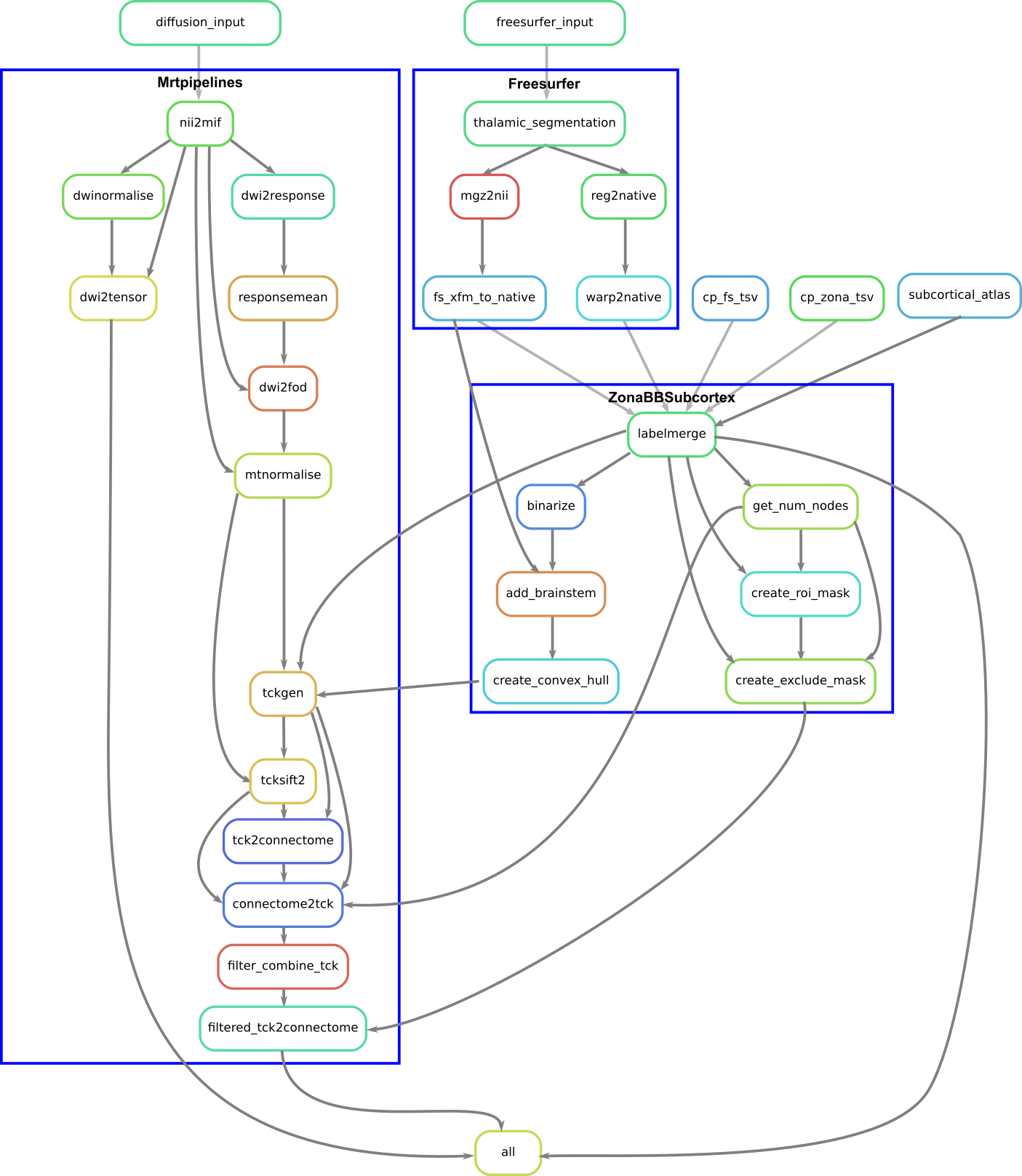
Although it may look complex, it is also organized into groups of rules, each
representing the different phases of the workflow. Each grouped set of rules
also exist in separate rule files, which can be found under the
rules sub-directories
in the workflow source. For example, the freesurfer.smk
file contains rules associated with further processing using Freesurfer
(e.g. thalamus segmentation), and these are grouped together in the above
diagram by a blue rectangle labeled freesurfer.
The main phases of the workflow are described in the sections below, zooming in on the rules within each blue rectangle.
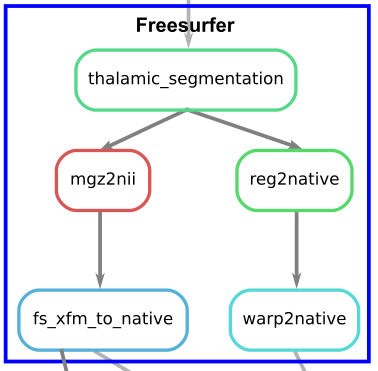
Freesurfer
Segmentation of the thalamus into its subnuclei is performed via the Freesurfer script. As the output from this segmentation is in the Freesurfer file format (.mgz), a conversion to nifti (.nii.gz) is performed. Once converted, a transformation is computed to align the segmentations from the Freesurfer space to the subject’s native space. The computed transformation is applied to the segmentations and used for further downstream processing.
Zona BB Subcortex
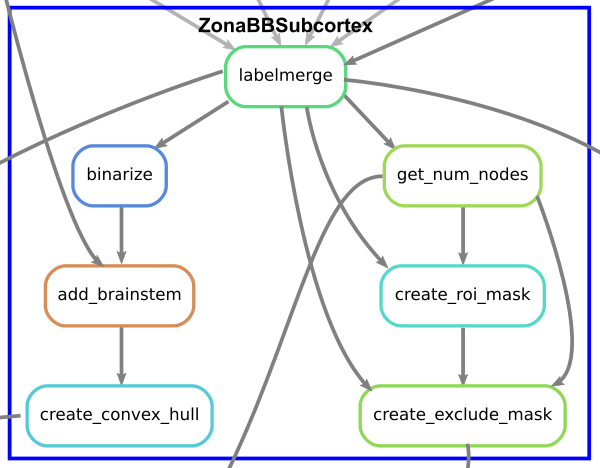
SCATTR also uses labelmerge to combine segmentations from varying sources. This allows for the previously segmented thalamic nuclei to be combined with an atlas of other subcortical structures. This newly combined atlas is used for two separate purposes:
To individual binarized masks for the structures of interest. This is used to identify connections terminating within these structures.
To create a convex hull (including the brainstem) allow for identification of only those connections within the larger region of interest (e.g. subcortical region around the subcortical structures)
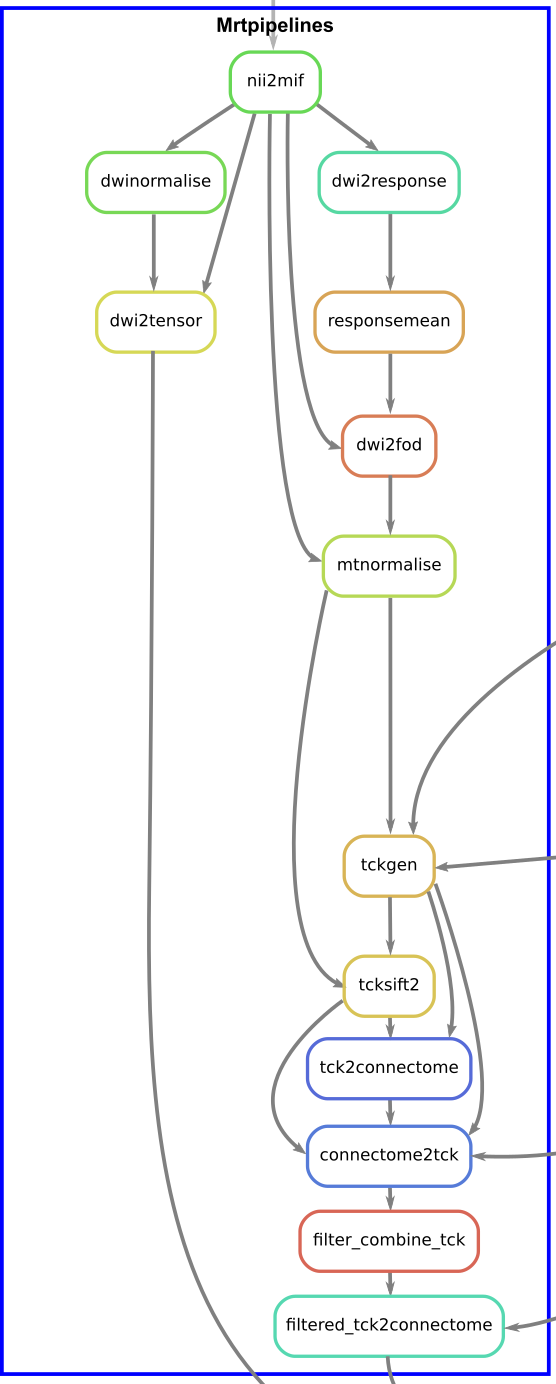
Mrtpipelines
MRtrix3 is used in the workflow for
tractography-related processing. These rules first convert the necessary nifti
images to the MRtrix file format, .mif. Similar to the subcortex workflow, two
different processes are performed:
Diffusion tensor imaging is performed to calculate quantitative maps of fractional anisotropy, mean diffusivity, radial diffusvity and axial diffusivity.
Individual subject response functions for the three tissue types, white matter, grey matter, and corticospinal fluid, are first estimated, and an average response function is then computed. Alternatively, a pre-computed response function can be supplied to be used in the downstream rules. From the average response functions, fibre orientation distribution (FOD) maps are computed for individual subjects. FOD maps are normalized to correct for the effects of (residual) intensity inhomogeneties. Once normalized, whole-brain tractogaphy is computed from the FOD maps, before spherical-deconvolutional filtering of tractograms (
tcksift2) is performed to weight the tractogram to match the underlying diffusion signal. Connections between specific structures of interest are identified, and further filtered to retain only those passing through the white matter (tck2connectome,connectome2tck,filter_combine_tck, andfiltered_tck2connectome).